GEO in 2026: The Complete Guide to Generative AI SEO
68% of all online experiences still begin with a search, but the search itself has changed forever.
Google AI Overviews and ChatGPT now reach 3 billion monthly users, and 80% of consumers rely on zero-click results in at least 40% of their searches.
What Is GEO (Generative Engine Optimization)?
Generative Engine Optimization is the practice of structuring your content so that AI-powered search platforms, Google AI Overviews, ChatGPT, Perplexity, Gemini, and Claude, retrieve, cite, and recommend your brand when answering user questions.
The term was formally introduced in a 2023 research paper by academics from Princeton University, Georgia Tech, IIT Delhi, and The Allen Institute for AI, and it has since grown into one of the most discussed disciplines in modern digital marketing.
The core idea is straightforward: traditional SEO earns you a position among ten blue links.
Generative AI SEO earns you a place inside the AI's answer itself, an implicit endorsement that no traditional organic listing can replicate. When an AI engine names your brand in its response, users receive it not as advertising, but as trusted synthesis.
That perception shift is enormously powerful, and it translates directly into business outcomes.
The term goes by several names, Answer Engine Optimization (AEO), Large Language Model Optimization (LLMO), Generative Search Optimization (GSO), but they all describe the same goal: get your content cited by AI.
The industry has not settled on a single label yet, but GEO has emerged as the most widely adopted shorthand.
Why GEO Matters More Than Ever in 2026
The numbers make the case better than any argument could. Two billion monthly users now engage with Google AI Overviews globally.
Meanwhile, 34% of traditional Google searches end without a single click, and that figure climbs further when AI Overviews are present. Users are getting their answers before they ever reach the results page, which means brands that are not cited in those answers are simply not part of the conversation.
So what happens to the traffic that does come from AI platforms? It converts. According to data from Ahrefs, AI-referred visitors convert at 23 times the rate of traditional organic search visitors. GEO delivers 4.4x higher conversions than traditional SEO.
The return on investment is equally compelling: for every dollar invested in GEO optimization, businesses see a return of $3.71.
Companies that have started seeing positive results report 300–500% returns within just six to twelve months of consistent implementation.
And yet the opportunity gap is staggering. Only 23% of marketers currently invest in prompt tracking and GEO measurement. That means the vast majority of your competitors are not doing this yet.
Right now, in early 2026, there is a genuine first-mover window available to brands willing to move with intention. The question is not whether to invest in generative AI SEO. It is how fast you can move.
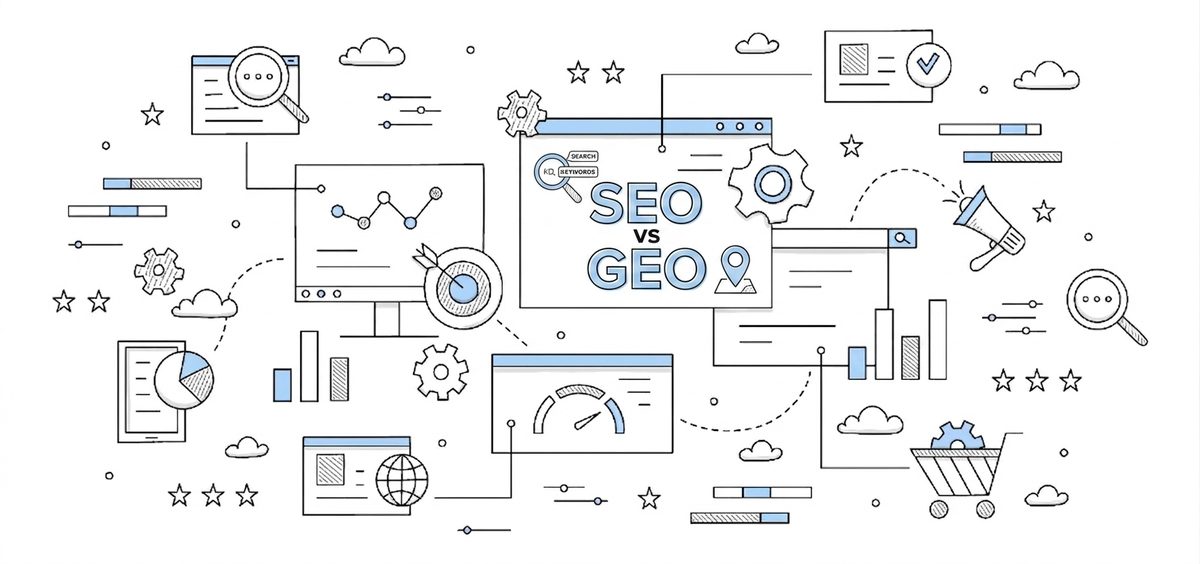
GEO vs. SEO: What Is Actually Different?
This is where a lot of marketers get confused, and the confusion is understandable. GEO and SEO share a substantial amount of their underlying logic, strong technical foundations, high-authority content, clear site architecture. But the end goal diverges in one critical way.
SEO gets you clicked. GEO gets you quoted.
Traditional search engines return a list of links and ask users to choose. Generative engines synthesize information from multiple sources into a single, conversational response.
Your content does not need to rank at the top of a list; it needs to be compelling, citable, and structured well enough that an AI chooses to extract and present it as authoritative information. That is a meaningfully different challenge.
Research from GEO firm Brandlight found that the overlap between top Google-ranked pages and AI-cited sources has dropped from 70% to below 20%. In other words, ranking well in Google no longer guarantees you will be cited by AI engines. 76.1% of URLs cited in AI Overviews do rank in Google's top 10, so SEO is still foundational, but ranking alone is not enough.
The additional layer is content structure, citation-friendliness, data richness, and what researchers call "extractability."
One more important framing: GEO does not replace SEO. The brands excelling at generative AI SEO are almost always the same brands with strong traditional SEO foundations.
Think of GEO as an additional layer you build on top of existing authority, not a substitute for it.
The Google AI Overviews Problem (And Opportunity)
Google AI Overviews are the most immediately visible manifestation of the GEO shift for most marketers.
When someone searches a question on Google and an AI-generated summary appears above the organic results, that is an AI Overview.
It pulls content from multiple sources, synthesizes an answer, and presents it before the user ever reaches the traditional results.
The challenge is real: when AI Overviews are present, organic click-through rates drop by 61%.
Pages that previously earned comfortable click volume from high-ranking positions are now seeing that traffic erode. This is not a temporary glitch. It is the new structure of the search results page.
But the opportunity is equally real. Pages cited in AI Overviews receive 35% more organic clicks and 91% more paid clicks than non-cited competitors on the same results page.
So if you are inside the Overview as a cited source, the traffic you receive is more qualified, more engaged, and more likely to convert. The goal is to shift from being below the Overview to being inside it.
To ai overviews optimize your content effectively, the structure needs to change. AI systems favor pages that lead each section with a direct, extractable answer, use question-based headers that mirror actual search queries, include specific statistics and data points with clear attribution, and present information in scannable blocks rather than dense narrative paragraphs.
These strategies for optimizing content for Google AI Overviews are not complicated in concept, but they require deliberate execution across every key page on your site.
Building a GEO Content Strategy That Works
A geo content strategy in 2026 is not a single tactic, it is a systematic approach to content creation, structure, and distribution that makes your material easy for AI systems to find, trust, and cite. Here is how to build one.
Lead With the Answer
AI retrieval systems, particularly those used by Perplexity and Google, evaluate a page's relevance primarily on its opening content.
The first 200 words of any article should directly and completely answer the primary query, not build up to it slowly.
This runs counter to traditional long-form blog writing conventions, where the introduction warms readers up before delivering substance. In generative AI SEO, the substance comes first, and the context follows.
Reformatting headers as questions also pays outsized dividends. A header that reads "What Is GEO?" is far more likely to be cited for the query "what is generative engine optimization" than one that reads "GEO Overview."
Audit your most important pages and rewrite H2 and H3 headers as questions that mirror the actual queries your audience types. Use Google Search Console to find what those queries are, then make them your subheadings.
Make Your Content Citation-Worthy
AI models heavily favor content that contains specific, citable data. A statement like "AI-driven GEO strategies deliver measurably higher conversion rates" is far less likely to be cited than "GEO delivers 4.4x higher conversions than traditional SEO, with an ROI of $3.71 per dollar invested." Specific numbers, named sources, and concrete claims are citation magnets for both AI systems and traditional backlinks.
Original research is even more powerful. If you publish proprietary data, a benchmark study, or a framework built from your own experience, AI engines have a reason to cite you over dozens of lookalike alternatives.
This is the core logic behind building a citation-worthy content library: not just writing good content, but writing content that is genuinely irreplaceable.
Address Fan-Out Queries
When someone asks an AI a complex question, the AI does not paste the full prompt into a search engine. It breaks the question into smaller sub-queries and searches for each one separately.
If someone asks "What is the best email marketing platform for a small e-commerce business?" the AI might search for "best email marketing platforms 2026," "email marketing e-commerce features," and "email marketing pricing small business" as three separate queries.
Your GEO content strategy needs to cover these fragments. Think about what pieces of a long question someone would search individually, then make sure your content addresses each one with depth and clarity. This sub-query coverage approach is one of the highest-leverage moves you can make to expand your generative AI SEO footprint without creating entirely new content.
Build Multi-Platform Authority
AI engines do not only pull from your website. They synthesize from everywhere, Reddit, YouTube, news publications, review sites, industry directories.
Research shows that 48% of AI citations come from community platforms and third-party sources, not owned sites. YouTube mentions and branded web mentions have the strongest correlation with AI visibility, outperforming traditional backlink counts.
So a complete geo content strategy includes building presence off your own domain: contributing to relevant forums, securing earned media coverage, building author authority profiles, and actively managing your brand's presence on review platforms and social channels. Digital PR is no longer separate from SEO. In the GEO era, it is core to the strategy.
Technical GEO: What AI Crawlers Actually Need
Before worrying about content optimization, you need to make sure AI systems can actually read your pages. This is the most frequently overlooked part of generative AI SEO, and it kills otherwise excellent strategies.
Check your robots.txt file first. Many sites inadvertently block AI crawlers without realizing it. Cloudflare changed its default configuration to block AI bots, if your site runs on Cloudflare, your AI bot traffic may have been shut off automatically.
Look for the "ChatGPT-User" user agent in your server logs to verify whether AI bots are actually visiting your site.
Beyond crawl access, implement structured data markup (schema) for FAQs, reviews, products, and how-to content. Use clear heading hierarchies with one topic per section.
Ensure your key content is server-side rendered rather than loaded via JavaScript, since many AI crawlers cannot execute scripts.
And consider creating an llms.txt file, a simple, machine-readable document that helps AI systems understand your site's structure, similar to how sitemap.xml serves traditional search crawlers.
Fast load times and mobile optimization still matter enormously. AI engines weigh technical quality when selecting sources, and a slow or poorly structured site signals lower trustworthiness regardless of content quality.
How to Measure GEO Performance
Measurement is the biggest gap in most GEO strategies right now. Only 23% of marketers currently track their performance in AI-generated answers, which means the other 77% are operating blind. You cannot optimize what you cannot see.
The metrics that matter for generative AI SEO are different from traditional SEO dashboards. Track AI citation frequency, how often your brand appears in AI-generated answers across platforms.
Monitor referral traffic from AI platforms (identifiable in GA4 via the "AI Overviews" channel grouping, or by filtering for chatgpt.com, perplexity.ai, and similar referrers).
Measure the quality of that traffic: bounce rate, session duration, and conversion rate from AI-referred visitors tend to tell a very different, usually much better, story than organic search averages.
Run regular citation audits. Query your target keywords and industry questions in ChatGPT, Perplexity, and Google AI Overviews.
Track whether your brand is mentioned, how it is described, and which competitors appear alongside or instead of you. This qualitative intelligence is as important as the quantitative data.
Also track content freshness. Research by Amsive found that 50% of content cited in AI search responses is less than 13 weeks old.
Content that was cited last month gets replaced by fresher sources this month.
Refreshing cornerstone content with updated data, a clear "Last Updated" timestamp, and new insights is not optional maintenance, it is an active GEO tactic.
Real-World GEO in Action: What Zapier Did Right
One of the clearest case studies in generative AI SEO comes from Zapier, the workflow automation platform. When Zapier noticed declining organic traffic coinciding with the expansion of AI Overviews, they did not create new content from scratch. They restructured what they already had.
Zapier added clear, extractable summaries at the beginning of each integration guide. They inserted specific statistics about time saved per workflow.
They added FAQ sections that directly addressed the most common follow-up questions their audience asked. Within three months, Zapier's content began appearing in AI-generated responses for automation-related queries.
Brand mentions in ChatGPT responses for "workflow automation" queries increased substantially, driving qualified traffic even as traditional SERP clicks declined.
The key insight is that GEO does not always require starting over. For many businesses, the highest-value move is restructuring existing authority, content that already has credibility and backlinks, to make it more AI-comprehensible.
Audit your top 10 pages by impressions and ask: does each section lead with a direct answer? Does each header mirror a real question? Does each claim include a specific, citable data point?
Those three changes alone can meaningfully shift your AI citation performance.
Common GEO Mistakes to Avoid
Most brands entering the generative AI SEO space make the same handful of errors, and they are worth naming explicitly so you can skip them.
The first mistake is over-structuring content for AI at the expense of human readers. Endless bullet points, robotic phrasing, and repetitive formatting frustrate the humans who find your content through any channel.
Balance AI comprehension with genuine readability. The best GEO content serves both audiences well.
The second mistake is optimizing for a single AI platform. Each engine, Perplexity, ChatGPT, Google AI Overviews, has slightly different citation patterns. Chasing one platform's quirks risks missing broader opportunities. Focus on universal principles: comprehensive, authoritative, clearly structured content. Those work everywhere.
The third mistake is treating GEO as a one-time project. Because AI systems favor recency, GEO is a continuous discipline. Content needs regular refreshing, citation audits need to run on a cadence, and your strategy needs to adapt as AI platforms evolve. Build GEO into your ongoing content operations, not just a quarterly initiative.
The GEO Market Opportunity You Cannot Ignore
The GEO market was valued at $886 million in 2024 and is projected to reach $7.3 billion by 2031, a 34% compound annual growth rate.
That trajectory reflects how rapidly businesses are recognizing that visibility in AI-generated answers is not a nice-to-have. It is revenue.
The competitive window is open right now, but it will not stay open. Early movers in GEO are already seeing results: higher-converting traffic, stronger brand perception, and visibility in places their competitors are entirely absent.
The brands that establish citation authority in AI responses today will own the conversations in their industries tomorrow. Citation authority, like domain authority before it, compounds over time.
Conclusion
GEO is the most significant shift in digital marketing since Google's introduction of PageRank.
The brands winning in this environment are those who have stopped waiting for GEO to become mainstream and started building the systems that earn AI citations today.
The core moves are clear: answer questions directly, include specific data, structure content for AI extraction, build authority across platforms, and measure what you cannot afford to ignore. Start with your top five revenue pages. Audit them against what AI systems actually need. Then iterate.
If you are serious about building a generative AI SEO strategy that delivers measurable results, Teknon provides the expertise to help you audit your AI visibility, optimize your content for citation, and track performance across every major AI platform.
Related content
No items found.